
AI no longer stops at insight. It helps move decisions into action.
AI is no longer experimental—it’s operational. Yet most systems still stop at insight. The Teradata Autonomous Knowledge Platform unifies data, AI, and analytics so intelligence moves from insight to action continuously, grounded in trusted enterprise context.
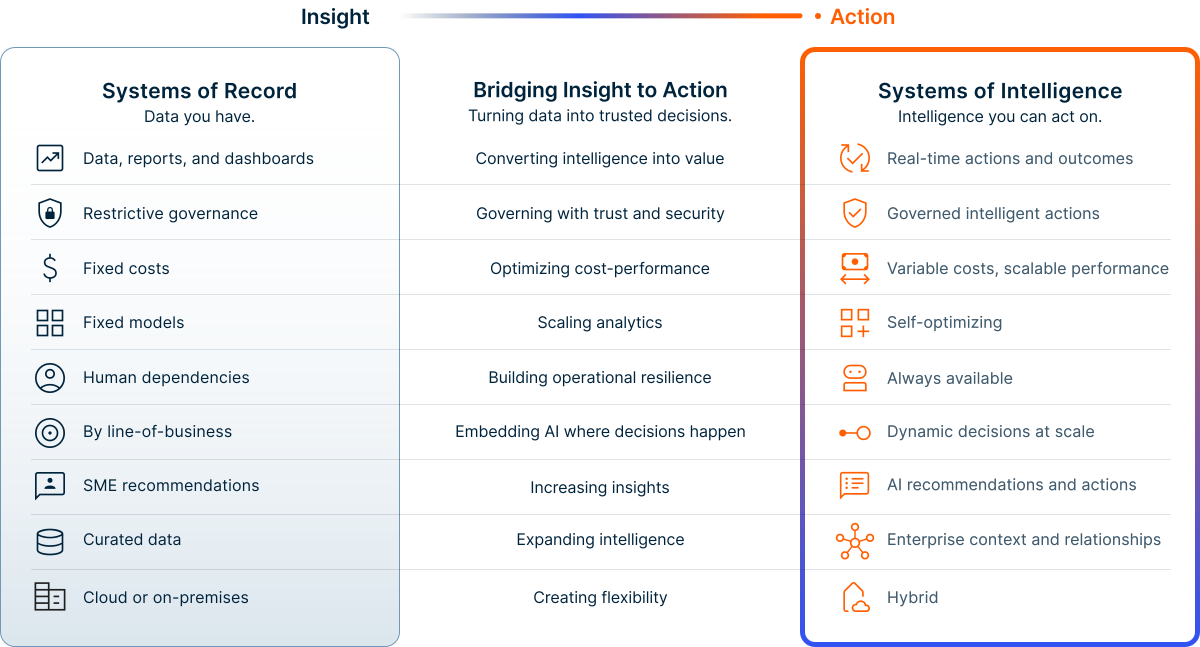
A platform where intelligence doesn’t stop
From foundation to knowledge to AI and agents, every layer is connected—so intelligence moves seamlessly from data to action. Most platforms stop at scaling compute. Teradata scales knowledge and execution in lockstep—so as demand grows, AI stays accurate, governed, and effective.
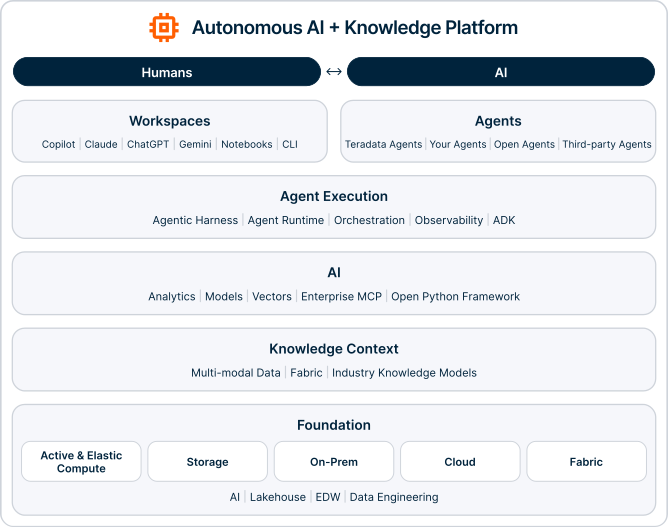
Built as a system for action—not a stack of capabilities
Most approaches to AI scale individual components—data, models, compute—in isolation. But as complexity grows, so does the distance between them. And that’s where intelligence breaks down. Teradata is built differently. Intelligence isn’t bolted together—it’s designed as a system from the ground up:
Connected
A connected data foundation unifies structured and unstructured data across every environment.
Agentic
Autonomous agents orchestrate decisions and execution in real time.
Fit-for-purpose
Fit-for-purpose compute dynamically balances performance, cost, and workload demands.
Hybrid
A hybrid operating model ensures consistency whether you're in the cloud, on premises, or navigating the strictest regulatory constraints.
From AI pilots to enterprise outcomes
Across industries, enterprises aren't experimenting with AI anymore. They’re running it in production, continuously and at scale, on the Teradata Autonomous Knowledge Platform:

A practical path from experimentation to execution
From insight to action—Teradata powers real-time decisions in production, driving measurable business impact.
Teradata Autonomous Knowledge Platform FAQ
Understand how Teradata’s fully integrated AI and Knowledge platform is designed to transform data into knowledge and activate enterprise intelligence at scale.
Category definition
What is the Teradata Autonomous Knowledge Platform?
What is the Teradata Autonomous Knowledge Platform?
The Autonomous Knowledge Platform unifies data management, analytics, AI, agentic execution, governance, and autonomous optimization—so organizations can move from isolated insights to continuously operating, trusted outcomes.
Why is autonomous knowledge important now?
Why is autonomous knowledge important now?
AI systems and agents operate continuously and at scale, requiring platforms built for high concurrency, governance, cost control, and operational reliability.
What is Autonomous AI + Knowledge?
What is Autonomous AI + Knowledge?
It’s a category that unifies data platforms, AI systems, and execution layers so intelligence can operate continuously—not just generate insights.
Why is this a new category?
Why is this a new category?
Autonomous knowledge is a new category because traditional platforms separate data, analytics, and AI, producing insights without operationalizing them. This category unifies data, AI, and execution so intelligence can continuously drive action, not just inform decisions.
What does Teradata mean by “knowledge”?
What does Teradata mean by “knowledge”?
Knowledge is data understood in business context—enriched with meaning and governance so it can drive decisions and actions.
How do autonomy and knowledge work together?
How do autonomy and knowledge work together?
Autonomy and knowledge work together by combining continuous system optimization with context-aware intelligence. Knowledge provides the meaning, relationships, and governance that ground AI systems, while autonomy ensures those systems can continuously operate, adapt, and execute actions at scale.
Platform overview
How is the platform “autonomous”?
How is the platform “autonomous”?
The Teradata platform continuously manages execution and improves knowledge without human intervention.
- System-level autonomy: Automatically optimizes compute, performance, cost, and data placement based on workload demand—so workloads run efficiently without manual tuning.
- Knowledge-level autonomy: Continuously updates and refines enterprise knowledge by incorporating new data, context, and outcomes—so AI systems improve how they reason and act over time.
Together, they enable continuous, self-optimizing intelligence. Systems don’t just generate insights. They operate, adapt, and act.
What problems does the platform solve?
What problems does the platform solve?
The platform is designed to allow customers to move from AI experimentation to enterprise production outcomes while maintaining security, governance, and cost control. It reduces fragmentation across data platforms and AI toolchains and minimizes data movement by providing a unified foundation for analytics and AI workloads, with governed execution.
What makes the platform different?
What makes the platform different?
It’s designed for machine-driven workloads—not just human interaction.
What business use cases does the Autonomous Knowledge Platform support?
What business use cases does the Autonomous Knowledge Platform support?
The platform supports a range of AI, lakehouse, and data engineering use cases, as well as other enterprise use cases, including:
- Retrieval-augmented generation (RAG)
- Fraud detection and risk modeling
- Customer intelligence and personalization
- Operational decision automation
- Multi-modal AI applications
What does the Teradata Autonomous Knowledge Platform build on from Teradata’s previous offerings?
What does the Teradata Autonomous Knowledge Platform build on from Teradata’s previous offerings?
The platform builds on Teradata’s enterprise software stack for AI and lakehouse workloads in an autonomous platform for scalable execution.
How does Teradata compare to other data and AI platforms?
How does Teradata compare to other data and AI platforms?
Most platforms specialize in data engineering, analytics, or AI development. Teradata differentiates by enabling continuous, governed execution at scale—combining data, AI, and operational decisioning in a single platform.
Does adopting the platform require re-platforming for existing customers?
Does adopting the platform require re-platforming for existing customers?
No. Existing Teradata customers can adopt new capabilities without fully re-architecting their current data, applications, or workflows.
Are there benchmarks that validate performance and cost?
Are there benchmarks that validate performance and cost?
Performance and cost vary by workload and environment. Teradata supports evaluation using real-world workloads, including side-by-side comparisons and migration-based validation to measure performance and efficiency.
What does it mean that the platform is built for machine-driven workloads?
What does it mean that the platform is built for machine-driven workloads?
The platform is designed for AI systems and agents—not just human users. It supports continuous, high-concurrency workloads where machines query, reason, and act at scale.
What deployment options are available?
What deployment options are available?
The platform supports cloud, on-premises, and hybrid deployments, allowing organizations to choose the model that best fits requirements for scale, cost, data residency, and regulatory needs.
How does the platform improve over time?
How does the platform improve over time?
The platform uses feedback loops from workloads, outcomes, and usage patterns to continuously optimize performance, cost, governance, and execution—improving how intelligence operates over time.
How does this benefit organizations?
How does this benefit organizations?
The platform enables organizations to run mission-critical workloads where they need to, while scaling innovation across environments—without re-architecting systems or compromising governance.
How can organizations evaluate the platform?
How can organizations evaluate the platform?
Organizations can evaluate the platform using proof-of-value programs, real-world workloads, and architecture reviews—covering cloud, on-premises, and hybrid deployment scenarios.
What capabilities are included?
What capabilities are included?
- AI Studio
- AgentStack (part of AI Studio)
- Enterprise Vector Store
- Teradata Database
- Connected Data Foundation
- Teradata Fabric
What is the Enterprise Vector Store?
What is the Enterprise Vector Store?
Teradata Enterprise Vector Store is an integrated, enterprise‑grade capability that manages, stores, and retrieves unstructured data using vector embeddings, enabling fast and intelligent search and retrieval as a trusted context layer for AI applications. Enterprise Vector Store enables hybrid search across structured and unstructured data within a governed environment.
How do developers use the Enterprise Vector Store?
How do developers use the Enterprise Vector Store?
Developers can access the Enterprise Vector Store through APIs and integrations supporting embedding, indexing, retrieval, and RAG workflows.
What’s the difference between a vector database and the Enterprise Vector Store?
What’s the difference between a vector database and the Enterprise Vector Store?
Vector databases store embeddings. The Enterprise Vector Store integrates vectors with structured data, governance, and workflows to provide accurate context for AI and analytics.
What is hybrid search in Teradata Enterprise Vector Store?
What is hybrid search in Teradata Enterprise Vector Store?
Hybrid search combines semantic (vector) search with lexical (keyword) search to deliver more accurate, context-aware results than either method alone, helping users find the right information across complex enterprise data sources.
What is fusion search across structured and unstructured data?
What is fusion search across structured and unstructured data?
Fusion search refers to retrieving insights across structured data (tables) and unstructured data (documents and other content) together, enabling richer context and better answers without requiring separate systems or complex stitching.
What types of unstructured data does the Enterprise Vector Store support?
What types of unstructured data does the Enterprise Vector Store support?
Enterprise Vector Store supports multi-modal unstructured formats including text, PDFs, images, audio, and video. Through integrations with NVIDIA and Unstructured, preprocessing and embedding generation are automated for unified ingestion.
What is the Connected Data Foundation?
What is the Connected Data Foundation?
The Connected Data Foundation is a unified data layer that provides consistent access to data across environments, formats, and platforms. It enables organizations to work with data wherever it resides—without duplication—while maintaining governance, performance, and scalability.
Why did Teradata rename its platform and products?
Why did Teradata rename its platform and products?
Teradata renamed its platform and products to use descriptive, plain-language names that reflect what the technology does, aligning with broader industry trends and improving clarity across the portfolio.
What product names have changed?
What product names have changed?
As of May 2026, the following Teradata product names have changed:
- Teradata Vantage® → Teradata Autonomous Knowledge Platform
- ClearScape Analytics®/AI Workbench → Teradata AI Studio
- QueryGrid® → Teradata Fabric
- Teradata VantageCloud → Teradata Cloud
- IntelliFlex®/AI Factory → Teradata Factory
Speak to the team
Discover what best-in-class data connectivity and analytics can do for your enterprise.