
Check your Snowflake and Databricks bill
We put Teradata, Snowflake, and Databricks through a rigorous, real-world workload comparison, measuring cost per query and query performance to show exactly how each platform holds up under the demands of modern data and AI. Before your next Snowflake invoice arrives, see how Teradata helps you do more with faster queries, smarter analytics, and production-ready AI, without paying more for it.
| Teradata | Snowflake | Databricks | |
|---|---|---|---|
| Cost per query |
$0.0009
Teradata
|
$0.0686
Snowflake
|
$0.0108
Databricks
|
| Queries processed |
197,366
Teradata
|
3,144
Snowflake
|
23,825
Databricks
|
Lowest average per-query cost
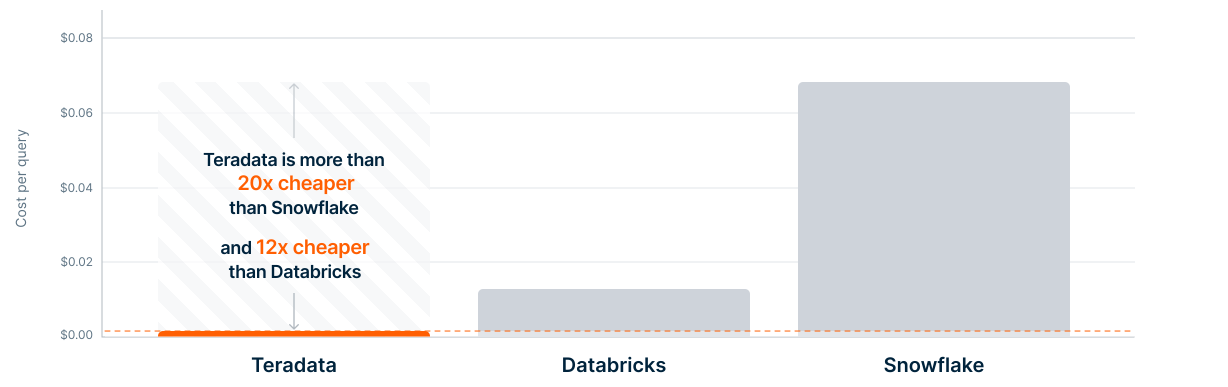
Cost per query comparison across Teradata, Snowflake, and Databricks using a $70 per compute-hour baseline.
The operational cost per query for each platform was analyzed using a base unit of $70 per compute hour. That represented the hourly cost of running each cloud-based platform under the following conditions:
- Generally available software versions
- Mid-tier platform offering
- One-year service pricing commitment
Each system was configured to maximize value within this budget constraint, utilizing the best publicly available knowledge for configuration and setup. The analysis demonstrated a stark contrast:
- Teradata: $0.0009 per query
- Snowflake: $0.0686 per query
- Databricks: $0.0108 per query
Teradata was found to be more than 20x cheaper than Snowflake and 12x cheaper than Databricks.
Highest query performance throughput
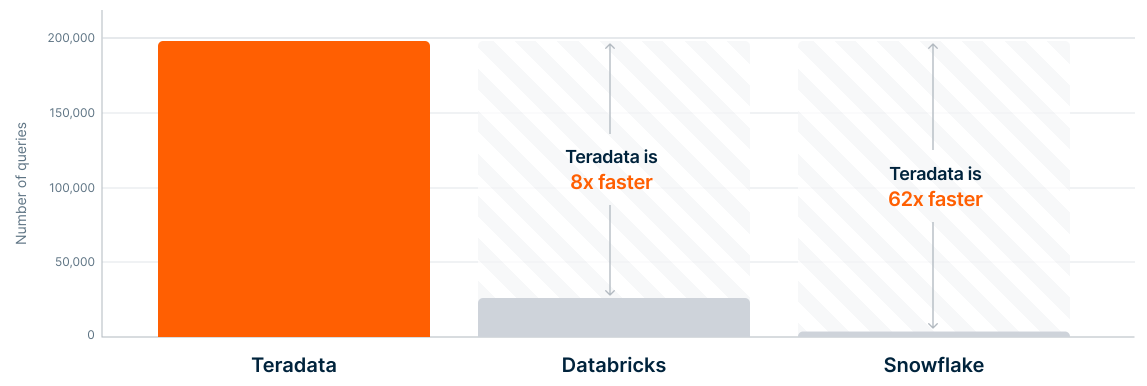
Query throughput comparison across Teradata, Snowflake, and Databricks using 50 queries representing mixed analytical workloads.
The analysis included 50 queries spanning multiple query types to simulate a modern, data-driven workload. We tested them over a two-hour period designed to gauge each platform's ability to handle complex analytical queries, operational reporting, and tactical queries that reflect the demands of data-driven organizations.
The analysis showed a massive difference between platforms:
- Teradata: 197,366 queries
- Snowflake: 3,144 queries
- Databricks: 23,825 queries
That means Teradata was able to handle 62 times more queries than Snowflake and 8 times more queries than Databricks in the same amount of time, under similar circumstances.
Claims above are based on real-world mixed analytical workloads on competitive systems of comparable configurations. For more information on the Teradata competitive workload comparison methodology and process, contact John.Myers@Teradata.com.
Workload comparison methodology: Teradata vs. Snowflake vs. Databricks
Study conducted by Teradata Market Intelligence (author: John Myers, Senior Director, Market Intelligence). Published July 2024 as “Cloud-Based Analytics Platforms: A Workload Comparison Study” (Version 1.0). Testing was performed by Teradata on generally available software versions as of that date. The methodology was designed to ensure fair and meaningful comparisons across platforms with different architectures. It has three components:
A real-world workload mix
The workload combines queries from an industry-standard decision support benchmark (TPC-H) with queries that simulate diverse, concurrent, operational analytics. It consists of 50 queries and a throughput test that runs continuously for two hours, stressing every layer of the platform, from query optimizer to workload management to storage, rather than running through a set of queries once.
Benchmark foundation: the 22 business-oriented queries from the Transaction Processing Performance Council’s TPC-H specification. Added queries: 28 queries simulating real-world, data-driven scenarios, including complex analytical queries, reporting, and operational analytics. Caching control: queries are parameterized so the same data is not requested in each round of execution, which limits caching. Note: this is a modified, Teradata-designed workload built on TPC-H. It is not an official, audited TPC-H result.
Cost-equivalent environments
The target was approximately $70 per compute hour for a base unit of processing, using generally available software versions, a mid-tier platform offering, and a one-year service pricing commitment. Exact parity was not possible because vendor pricing and node specifications differ. Each system was configured to maximize value within that budget using best practices and publicly available configuration guidance. During the test, each system could scale up to four units of processing, so actual costs diverged from the base unit cost depending on how each platform scaled.
Minimized tuning
No workload-specific tuning was performed. Performance features that DBAs would commonly enable and that were generally available were deployed. This included materialized views, deployed on select larger tables in line with DBA best practices on every platform that offered them. Teradata calls this feature a “single table join index,” and Snowflake calls it a “materialized view.” Databricks did not offer it as a generally available feature when the test was executed, so it was not included in the Databricks configuration.
Enterprise price performance formula
Enterprise price performance = Hourly testing cost ÷ Queries completed per hour (reported as cost per query).
Results
Teradata vs. Snowflake vs. Databricks: 2-hour throughput test
| Teradata Vantage Cloud | Snowflake | Databricks | |
|---|---|---|---|
| Base unit cost (per compute hour) |
$69.31
Teradata Vantage Cloud
|
$72.00
Snowflake
|
$72.80
Databricks
|
| Actual two-hour testing cost |
$358.25
Teradata Vantage Cloud
|
$431.25
Snowflake
|
$513.05
Databricks
|
| Queries completed per hour |
197,366
Teradata Vantage Cloud
|
3,144
Snowflake
|
23,825
Databricks
|
| Cost per query |
$0.0009
Teradata Vantage Cloud
|
$0.0686
Snowflake
|
$0.0108
Databricks
|
| Cost relative to Teradata |
1x
Teradata Vantage Cloud
|
~75x
Snowflake
|
~12x
Databricks
|
In this test, Teradata completed the most queries per hour at the lowest cost per query. The study attributes the difference in actual cost to scaling behavior: Snowflake and Databricks provisioned additional compute more aggressively as demand rose, while Teradata used its available compute more fully before scaling, relying on its query optimization and workload management.
These results reflect a Teradata-conducted test of a specific mixed analytical workload on cost-equivalent, not identical, configurations. Results will vary with workload, configuration, and pricing. For more on the Teradata competitive workload comparison methodology, contact John.Myers@Teradata.com.
Learn more
Related resources


Frequently asked questions
Workload comparison FAQs
How to get started
Get started with your migration to Teradata today
Fill out the form to engage with Teradata specialists to discuss your specific requirements and objectives and develop a customized migration plan tailored to your needs.